Journal article · 2025
Inverse design of concrete beam-column joints with complex cross-sections based on data-driven
Structures 82, 110484 (2025)
DOI: 10.1016/j.istruc.2025.110484Abstract
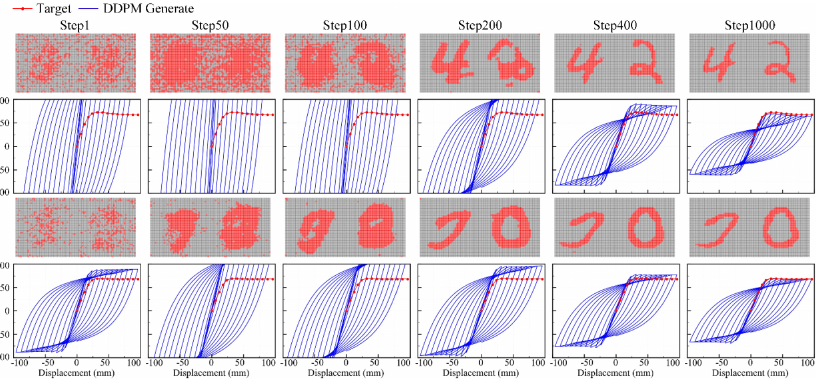
Drawing Inspiration from generative artificial intelligence, this study proposes an inverse design methodology for beam-column joints based on the Denoising Diffusion Probabilistic Model (DDPM). Unlike conventional forward design approaches, the proposed method enables the direct generation of structural cross-sections from prescribed mechanical performance, represented by target skeleton curves. The DDPM is trained to learn the conditional distribution of feasible joint geometries given a specific input curve, effectively inverting the typically implicit structure-property relationship. To ensure adequate training data, 70,000 samples were generated based on the MNIST dataset, with 60,000 allocated for training and 10,000 for testing. The DDPM learns the conditional distribution of beam-column joints given a specific skeleton curve, thereby effectively mapping performance requirements to sectional design parameters. Numerical simulations demonstrate that the DDPM can generate a variety of beam-column sections based on prescribed mechanical performance and can even produce accurate joint sections for skeleton curves not present in the training dataset. The quantitative structural simulation results indicate that 98.3 % of the generated cross-sections have mechanical behavior with a mean error controlled within 10 % of the target curve. This indicates the effectiveness and accuracy of the DDPM in generating beam-column sections that meet desired performance criteria. The proposed inverse design framework highlights the potential of DDPM for intelligent structural design. Future work will explore extending this approach to achieve the inverse design of entire structures.
Citation
Yijie Cai, Tianyang Zhang, Yujie Lu, Weizhi Xu, Shuguang Wang, Dongsheng Du. Inverse design of concrete beam-column joints with complex cross-sections based on data-driven [J]. Structures, 2025, 82: 110484. https://doi.org/10.1016/j.istruc.2025.110484