Research theme
AI-Driven Structural Design
Performance-driven inverse design starts with a desired mechanical response and seeks compatible structural geometries. Tianyang Zhang and collaborators investigate conditional diffusion models for this one-to-many mapping, using latent representations and mechanical response evaluation to connect generation with structural engineering.
From mechanical targets to structural topology
Target curves act as design conditions. Diffusion models learn distributions of feasible geometries rather than a single deterministic geometry for each target.
Inverse design of energy-dissipating steel plate walls based on self-supervised diffusion models
Tianyang Zhang, Yinxiao Lv, Tong Liu, Weizhi Xu, Shuguang Wang, Dongsheng Du, Aiguo Zhao
Thin-Walled Structures · 2025Investigates self-supervised diffusion for energy-dissipating steel plate walls and checks generated configurations against target mechanical performance.
Inverse design of concrete beam-column joints with complex cross-sections based on data-driven
Yijie Cai, Tianyang Zhang, Yujie Lu, Weizhi Xu, Shuguang Wang, Dongsheng Du
Structures · 2025Uses a denoising diffusion probabilistic model to generate concrete beam-column joint cross-sections from target skeleton curves, with numerical evaluation of generated sections.
Latent diffusion for nonlinear, multiaxial targets
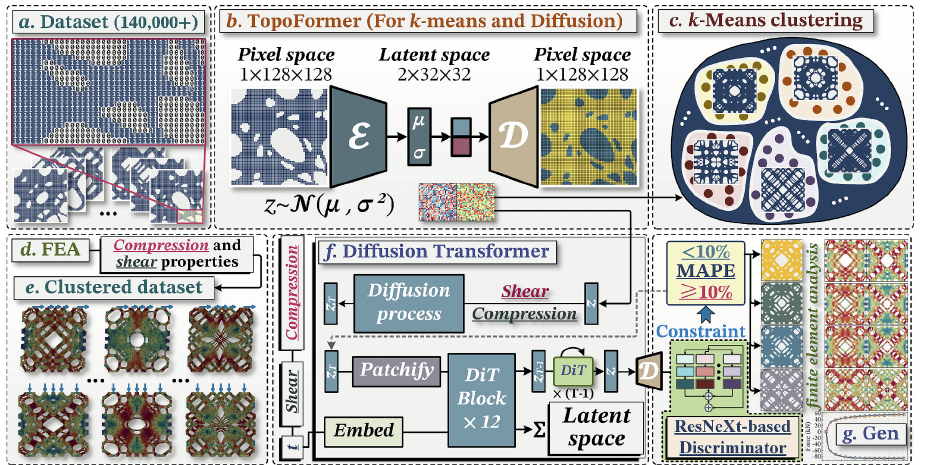
A compact representation reduces the dimensionality of topology generation. In this study, the design conditions include nonlinear shear and compression responses rather than only a scalar stiffness or strength target.
Latent diffusion–driven inverse design of damping microstructures with multiaxial nonlinear mechanical targets
Tianyang Zhang, Weizhi Xu, Shuguang Wang, Dongsheng Du
Advanced Engineering Informatics · 2026Combines a variational-autoencoder-based TopoFormer with a conditional diffusion Transformer. The workflow connects topology generation, three-dimensional reconstruction, fabrication, and mechanical verification.
Scale-aware generation with response constraints
Changing array scale can alter mechanical response. A multiscale generative model therefore needs to account for both geometric scale and the requested structural performance.
MultiDampGen: A self-constraint latent diffusion framework for multiscale energy-dissipating microstructure generation
Tianyang Zhang, Weizhi Xu, Shuguang Wang, Dongsheng Du
Applied Soft Computing · 2026MultiDampGen integrates latent topology compression, direct hysteresis prediction, and conditional synthesis for shear-dominated energy-dissipating microstructures.
Scope of the evidence
Topology generation and performance verification are separate steps. Feasibility and generalization should be assessed within each paper's reported design domain; the studies do not establish unrestricted generation for arbitrary structures or loading histories.