Journal article · 2025
Rapid inversion of seismic damage to masonry infill walls based on diffusion models
Engineering Failure Analysis 171, 109371 (2025)
DOI: 10.1016/j.engfailanal.2025.109371Abstract
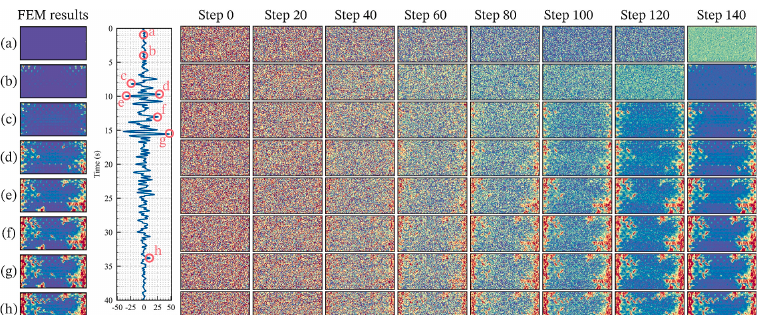
Masonry infill walls, which are weak links in current seismic designs, rely on numerical simulations to evaluate their seismic performance. As traditional macroscopic and microscopic finite element modelling (FEM) cannot simultaneously account for the damage evolution process and achieve sufficient computational efficiency for masonry infill walls, this study developed a damage inversion model (DIM) for infill walls based on diffusion models. The DIM can extract features from the macroscopic interstory deformation process of existing structures and use them as prompts to directly generate the damage factor distribution of masonry infill walls under the corresponding conditions. By varying the sampling steps and noise schedule in the DIM generation process, it was found that for the denoising diffusion probabilistic model (DDPM), the sampling steps should be set to over 500 to achieve a structural similarity (SSIM) of 0.87 compared with the microscopic FEM results. Conversely, the diffusion exponential integrator sampler (DEIS) can achieve a DDPM accuracy of 90.51% using only 1% of the DDPM sampling steps, balancing computational efficiency and predictive accuracy. Therefore, the DEIS has the potential to be developed into larger, more complex models for predicting the damage distribution of infill walls throughout the entire seismic process.
Citation
Tianyang Zhang, Yujie Lu, Yijie Cai, Weizhi Xu, Shuguang Wang, Dongsheng Du, Qisong Miao. Rapid inversion of seismic damage to masonry infill walls based on diffusion models [J]. Engineering Failure Analysis, 2025, 171: 109371. https://doi.org/10.1016/j.engfailanal.2025.109371