Research theme
AI for Structural Earthquake Engineering
Artificial intelligence can support several distinct tasks in earthquake engineering: estimating structural response, reconstructing damage distributions, and generating structures for specified mechanical demands. The papers below address these tasks using response databases, diffusion models, and mechanics-based verification.
Seismic response prediction and damage assessment
Response prediction maps a structure and ground-motion information to response measures. Damage assessment instead estimates a damage state. These are related but different problems, and their validation data should not be treated as interchangeable.
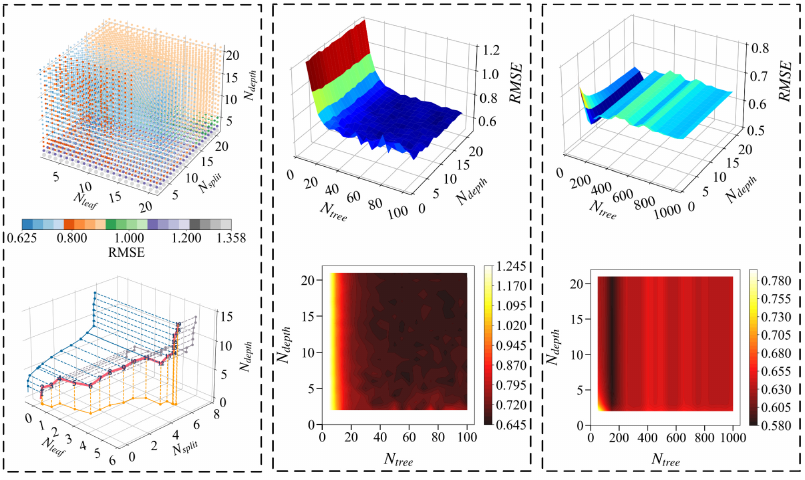
Seismic response prediction of a damped structure based on data-driven machine learning methods
Tianyang Zhang, Weizhi Xu, Shuguang Wang, Dongshen Du, Jun Tang
Engineering Structures · 2024Compares interpretable machine learning, a convolutional network, and a seismic-wave Transformer for maximum inter-storey displacement prediction. An aggregation model combines complementary prediction methods across nonlinear response regimes.
Study on the evolution of dynamic characteristics and seismic damage of a self-centering concrete structure based on data-driven methods
Tianyang Zhang, Weizhi Xu, Shuguang Wang, Dongsheng Du, Qisong Miao
Engineering Structures · 2024Combines incremental dynamic analysis, time-frequency analysis, and a convolutional neural network to study damage in a precast self-centering concrete frame. Attribution methods examine the frequency components used for damage classification.
Diffusion models for seismic damage inversion
Damage inversion reconstructs spatial damage from a lower-dimensional structural response. Here, diffusion is used to generate a damage field, not to design a new structural topology.
Rapid inversion of seismic damage to masonry infill walls based on diffusion models
Tianyang Zhang, Yujie Lu, Yijie Cai, Weizhi Xu, Shuguang Wang, Dongsheng Du, Qisong Miao
Engineering Failure Analysis · 2025Conditions a diffusion model on macroscopic interstory deformation histories to generate masonry infill-wall damage distributions, with microscopic finite-element results as the reference.
Generative design for seismic energy dissipation
The inverse-design studies connect mechanical performance requirements to structural geometry. Their engineering relevance comes from evaluating the generated structures against those requirements, rather than visual similarity alone.
Inverse design of energy-dissipating steel plate walls based on self-supervised diffusion models
Tianyang Zhang, Yinxiao Lv, Tong Liu, Weizhi Xu, Shuguang Wang, Dongsheng Du, Aiguo Zhao
Thin-Walled Structures · 2025Develops SSIDM for energy-dissipating steel plate walls, coupling diffusion-based topology generation with a hysteresis performance prediction network and finite-element evaluation.
Latent diffusion–driven inverse design of damping microstructures with multiaxial nonlinear mechanical targets
Tianyang Zhang, Weizhi Xu, Shuguang Wang, Dongsheng Du
Advanced Engineering Informatics · 2026Links multiaxial nonlinear mechanical targets to damping microstructures through latent diffusion, with finite-element and cyclic-loading experimental validation.
MultiDampGen: A self-constraint latent diffusion framework for multiscale energy-dissipating microstructure generation
Tianyang Zhang, Weizhi Xu, Shuguang Wang, Dongsheng Du
Applied Soft Computing · 2026Extends conditional generation to multiscale damping microstructures through TopoFormer, a response validator, and a latent diffusion physics mapper.
Scope of the evidence
The evidence is specific to the structures, loading conditions, and datasets studied in each paper. These methods do not replace project-specific analysis, experimental validation, or applicable seismic design requirements.