Journal article · 2026
MultiDampGen: A self-constraint latent diffusion framework for multiscale energy-dissipating microstructure generation
Applied Soft Computing 186, 114194 (2026)
DOI: 10.1016/j.asoc.2025.114194Abstract
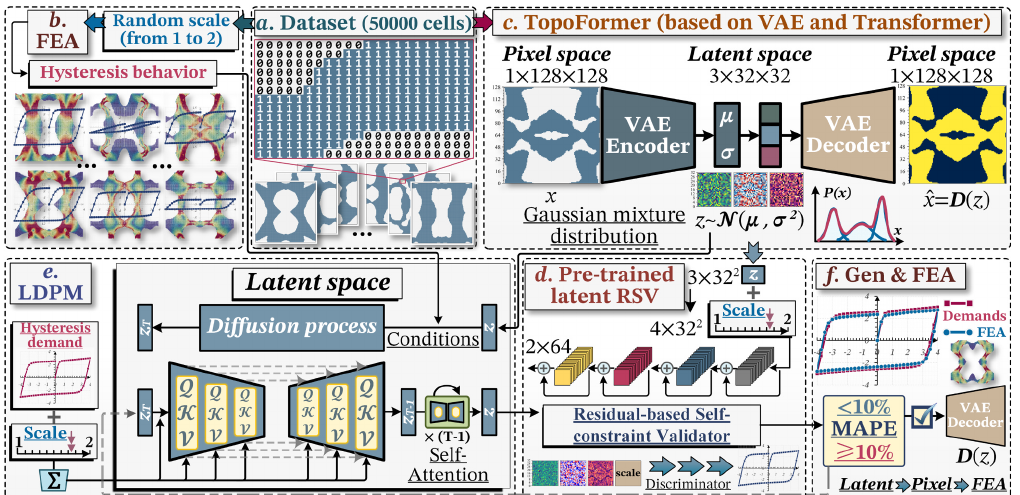
This study proposes MultiDampGen, a physics‐informed latent diffusion framework that generates multiscale, shear‐dominated damping microstructures aimed at seismic energy dissipation. The framework integrates a topology transformer (TopoFormer) for attention-enhanced latent compression, a residual-based self-constraint validator (RSV) for direct hysteresis prediction, and a latent diffusion physics mapper (LDPM) for conditional synthesis. A dataset comprising 50,000 finite‐element–computed hysteresis curves under cyclic shear loading was constructed as the foundation of the proposed framework. Experimental results show that TopoFormer achieves a structural similarity index (SSIM) of 0.998 while reducing generative complexity by over 90 %, and RSV predicts complete hysteretic responses with an R2 exceeding 0.98. MultiDampGen can generate microstructures meeting specified mechanical performance and scale requirements with deviations within 10 %, even under conflicting constraints such as a large scale combined with low load‐bearing capacity. The framework enables efficient exploration of non-intuitive yet physically consistent designs, advances the application of generative artificial intelligence in earthquake engineering, and offers new insights for the development of next-generation energy dissipation systems.
Citation
Tianyang Zhang, Weizhi Xu, Shuguang Wang, Dongsheng Du. MultiDampGen: A self-constraint latent diffusion framework for multiscale energy-dissipating microstructure generation [J]. Applied Soft Computing, 2026, 186: 114194. https://doi.org/10.1016/j.asoc.2025.114194